Nasal Obstruction
Septoplasty: a straighter septum,easier breathing.
When the wall between your nostrils is bent enough to block airflow, straightening it is a routine part of Dr. Khetani's surgical practice: through the nostrils, with no external incisions and no change to how your nose looks.
Septoplasty straightens the internal wall of the nose (the septum) to improve airflow; it is done through the nostrils, leaves no external scar and does not change the nose’s appearance. It is insured under OHIP when medically necessary — OHIP pays the surgeon and the hospital. An OHIP-insured assessment begins with a referral from your physician or nurse practitioner.
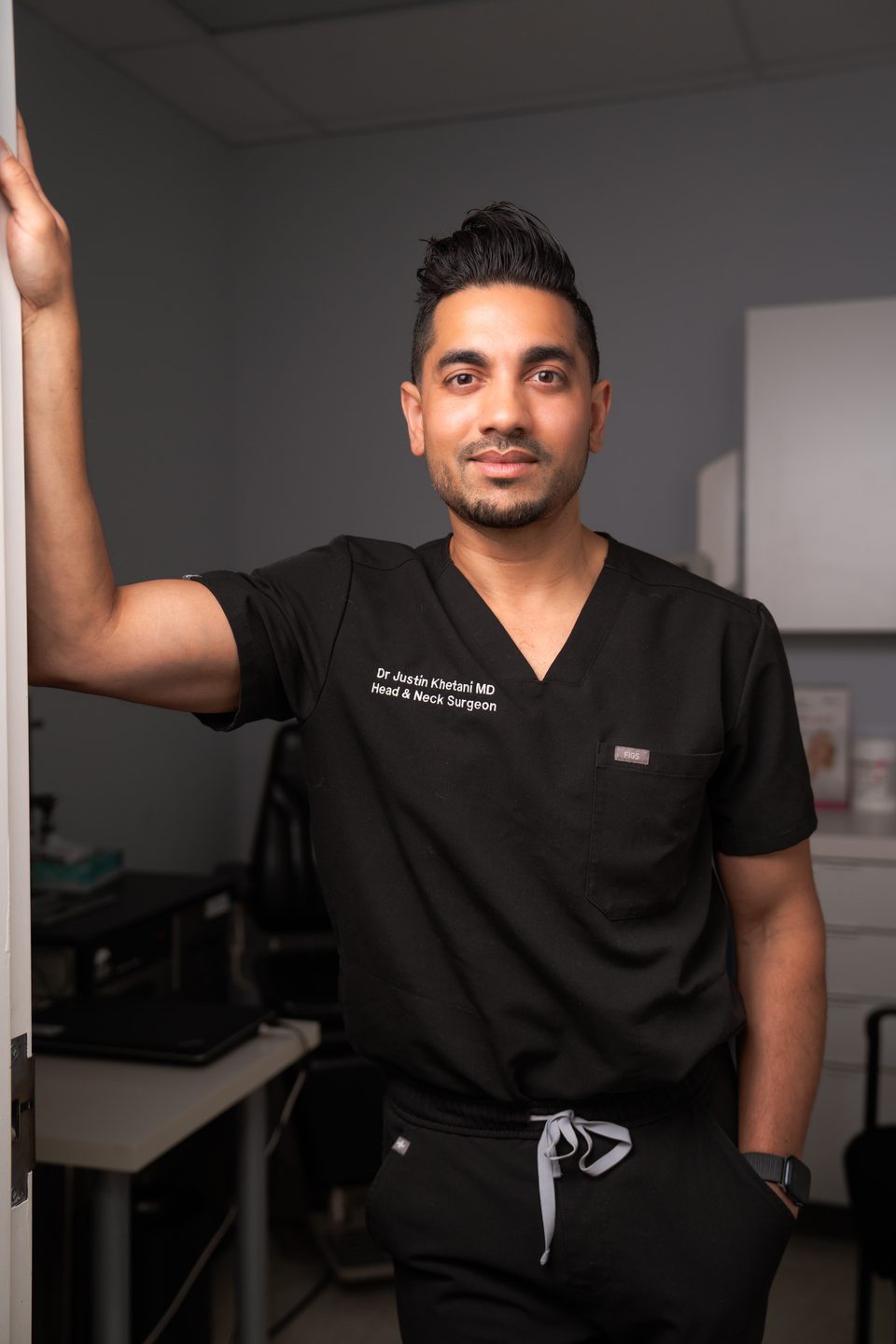
Written and reviewed by Dr. Justin Khetani, MD, FRCSC, Otolaryngology–Head and Neck Surgery · Last reviewed
Fellowship-trained in rhinology & anterior skull base surgery (University of Alberta) · The daily surgical work of the practice is the nasal airway · Surgery at Joseph Brant Hospital
- Coverage
- Insured under OHIP when medically necessary — OHIP pays the surgeon and the hospital.
- Referral
- Begins with a referral from your physician or nurse practitioner.
General guidance only. Your diagnosis, plan, recovery and coverage are individual, and are confirmed at your consultation.
The Problem
What a deviated septum actually does.
The septum is the wall of cartilage and bone dividing the nose into two passages. Few septums are perfectly straight, but when the deviation is significant, from growth or from injury, it narrows one or both airways and the nose stops doing its job quietly.
That can show up as blocked breathing on one or both sides, congestion that never fully clears, breathing that worsens when you lie down, mouth breathing and disrupted sleep, snoring, recurrent sinus infections, or nosebleeds from turbulent airflow across the bent segment.
Diagnosis is direct: a focused history and an internal examination (including nasal endoscopy where indicated) establish where the blockage is and whether the septum, the turbinates, the nasal valves or several together are responsible.
The deviated septum in full: symptoms, assessment and every option

Deviated · Corrected
Fig. The septum, straightened in place.
The Operation
Through the nostrils, without changing your nose.
Septoplasty is performed entirely through the nostrils under general anesthesia, usually as day surgery. Working beneath the septum's lining, Dr. Khetani straightens or conservatively removes the deviated portions of cartilage and bone, preserving the support the nose relies on. The outward appearance of the nose is unchanged.
Where enlarged turbinates also narrow the airway (common alongside a deviated septum), a turbinate reduction is often performed in the same operation. And where the septal deviation also bends the visible nose, or you'd like appearance addressed at the same time, the operation becomes a septorhinoplasty: one anesthetic, one recovery.
Recovery
What recovery generally looks like.
Individual recoveries vary. These are the general patterns, refined for your case in your post-operative instructions.
Expect a congested, stuffy nose: the internal swelling of healing, sometimes with soft internal supports in place. Light spotting of blood is common early on. Saline rinses, rest with the head elevated, and not blowing your nose are the core of early care; specifics are set out in your written instructions.
Many patients return to desk work within several days to a week or so, once congestion and energy allow. Strenuous exercise and heavy lifting generally wait one to two weeks or until cleared at follow-up. Any internal supports are removed at an early follow-up visit.
Breathing typically improves progressively as internal swelling settles over the following weeks; the early congestion is not the final result. Follow-up visits confirm the airway is healing as intended.
The septoplasty patient guide: preparing, risks and the hospital day
The Honest Part
A routine operation is still an operation.
Septoplasty is common and generally well tolerated, but like any surgery it carries risks: bleeding, infection, the risks of general anesthesia, a small hole in the septum (septal perforation), numbness of the front teeth or palate that is usually temporary, persistent or recurrent obstruction, and, rarely, a change in the shape of the nose.
Two of those deserve a sentence more. Cartilage has a degree of memory, so over time a corrected septum can drift back toward its old shape; that is one reason obstruction can sometimes return. And a septal perforation is often symptom-free, though it can announce itself as whistling, crusting or nosebleeds.
These are reviewed with you plainly at consultation, alongside the likelihood that surgery will genuinely help your particular pattern of obstruction. If the honest answer is that it won't, you'll hear that instead.
Watch
Septoplasty, explained on camera.
Two short videos, in Dr. Khetani's own words: what the operation involves and the risks that come with it, then what the first weeks of recovery are actually like.
Video 1 of 2
The operation and its risks
What a deviated septum does to the airway, how it is straightened through the nostrils without changing the outside of the nose, and the risks reviewed at consultation: bleeding, infection, septal perforation, temporary numbness, recurrence of obstruction, and the risks of general anesthesia.
About 4 minutes · captioned · general education, not advice about your case
Video 2 of 2
After septoplasty: what to expect
The congested first days, internal supports and when they come out, saline rinses, when breathing typically starts to improve, when to return to work and exercise, and the signs that mean you should call the office.
About 3 minutes · captioned · general education, not advice about your case
The videos are general education, recorded by Dr. Khetani for patients considering or recovering from this operation. They are not advice about your case: risks, recovery and results vary from person to person and are discussed with you individually.
Getting Assessed
The pathway is medical.
Referral first
Nasal obstruction is a medical concern: assessment generally begins with a referral from your physician or nurse practitioner, faxed to (905) 639-2253. The office contacts you once the referral is processed. Physicians: referral information.
OHIP coverage
Septoplasty and related airway surgery are insured under OHIP when medically necessary — OHIP pays the surgeon and the hospital. What that means in your situation is confirmed at consultation. How OHIP coverage works →
Combined goals
If you also want the appearance of your nose addressed, say so at consultation: a combined septorhinoplasty may make sense, and the insured and uninsured parts are identified separately, in writing, before anything is decided.
Your realistic options, side by side
| Option | What it can offer | Trade-offs to weigh |
|---|---|---|
| Managing without surgery | Where congestion is driven by the nasal lining rather than the structure, treating the lining medically may be enough. | No medication straightens cartilage or bone; if the septum itself is the obstacle, relief from medical treatment alone tends to be partial. |
| Septoplasty, with turbinate reduction where indicated | Straightens the structural blockage through the nostrils, with no external incisions and no change to how the nose looks. | Day surgery under general anesthesia with real risks, and congested early weeks before breathing improves progressively. |
| Septorhinoplasty | One anesthetic and one recovery where the deviation also bends the visible nose, or you want appearance addressed at the same time. | A larger operation planned differently: the insured and uninsured parts are identified separately, in writing, before anything is decided. |
Set out so you can weigh the options yourself. Which of them fits your pattern of obstruction is established by examination at consultation, and the decision stays yours.
Common Questions
Septoplasty, answered plainly.
No. Septoplasty works entirely inside the nose and does not change its outward appearance. If a bent septum is also bending the visible nose, or you would like appearance addressed at the same time, that becomes a septorhinoplasty, which is planned differently and discussed openly at consultation.
Septoplasty for nasal obstruction is insured under OHIP when medically necessary — OHIP pays the surgeon and the hospital. Surgery to change the appearance of the nose is not insured by OHIP. Where one operation addresses both breathing and appearance, the insured and uninsured parts are identified separately, in writing, before anything is decided. The details are on the What OHIP covers page.
No. Dr. Khetani does not pack the nose after septoplasty. Instead, soft splints (Doyle splints) are usually placed inside the nose to support the septum while it heals. How long they stay in depends on how severe the deviation was and how much surgery was needed: often about one week, and in rare cases two to three weeks. They are removed at a follow-up visit, and you are told before surgery what to expect.
Not immediately: the first days to weeks are congested while internal swelling settles, and breathing then improves progressively. Judge the operation by the settled result over the following weeks, not by the first few days; follow-up visits track exactly that.
Possibly either; possibly both. The septum and the turbinates each narrow the airway in different ways, and they frequently contribute together. Examination, including endoscopy where indicated, establishes which is responsible in your nose; where both are, they are commonly addressed in the same operation.
Find out what's actually blocking your nose.
Ask your physician or nurse practitioner for a referral, or contact the office with any questions about the process.
Septoplasty referrals arrive from family physicians and nurse practitioners across Burlington, Oakville, Milton, Georgetown and Halton Region, Hamilton, Brampton and the Niagara Region. Consultations are held at the Burlington office and surgery takes place in hospital in Burlington.