Patient Information
From referralto recovery.
How care is organized at the Burlington office: getting seen, what happens at consultation, preparing for surgery, and what follow-up looks like afterwards.
01 / 06
Two pathways, depending on why you're coming.
Ontario treats medical and cosmetic care differently. Knowing which describes your situation makes the first step straightforward.
If a "How to Get Seen" link brought you here, this is the place: every route into the practice starts with one of the two pathways below.
Pathway One
Medical: by referral
For blocked nasal breathing, chronic sinusitis, nasal polyps, recurrent infections or nasal injury. Ask your family physician, walk-in physician or nurse practitioner to fax a referral to (905) 639-2253.
- Your physician faxes the referral to the office.
- The office contacts you to arrange your consultation.
- Assessment: insured when medically necessary.
Wait times depend on urgency and current volumes; the office can tell you what to expect when they call. Physicians and nurse practitioners: what to include on a referral.
Access & wait times
- Chronic sinus disease, confirmed on CT
- Consultation within weeks of referral; surgery, where indicated, typically within about three months
- Nasal polyps (CRSwNP), confirmed on CT
- Assessment within four months of referral, under the Canadian Rhinologic Society directory of fellowship-trained rhinologists (opens in a new tab) commitment the practice is listed under
These are the practice's current patterns, not promises: individual timing depends on assessment, urgency and hospital scheduling.
Figures reviewed: September 2026
Pathway Two
Cosmetic: request directly
For rhinoplasty sought to change the appearance of your nose, or for non-surgical facial treatment. No referral is needed, and cosmetic care is not insured.
- Request a consultation by phone or through the form.
- The office confirms availability and any consultation fee.
- Costs are quoted in writing after your assessment.
If your concern turns out to include a breathing problem, that part is assessed the same day and its coverage explained.
Where patients travel from
Both pathways serve a wide catchment. Referrals arrive from family physicians and nurse practitioners across Burlington, Hamilton, Oakville, Milton, Waterdown, Ancaster, Dundas, Stoney Creek and Grimsby, and patients travel from Georgetown, Halton Hills, Brampton, Mississauga, Guelph, Cambridge, Kitchener, Brantford, St. Catharines and Niagara Falls for subspecialty care of the nose and sinuses. From most of these communities the office is within about an hour's drive.
The logistics are simpler than they look from a distance: consultations and follow-up visits happen at the Plains Road East office, minutes from Highway 403 and close to the QEW, and surgery takes place in hospital in Burlington or Hamilton. If you are travelling from further away, mention it when your consultation is arranged so the visit can be planned with that in mind.
02 / 06
Your Consultation
What actually happens at the first visit.
-
History & goals
What's bothering you, how long it has gone on, what you've already tried, and what you'd like to be different. Bring your medication list and any prior imaging or operative records.
-
Examination
Examination of the nose outside and inside. Where indicated, nasal endoscopy, a thin camera passed into the nose after a topical spray, gives a direct view of the septum, turbinates and sinus openings.
-
Explanation
What Dr. Khetani found, in plain language: the diagnosis, the realistic options, the benefits and risks of each, and what OHIP does or doesn't cover.
-
Decision (or no decision)
You're under no obligation to decide anything at the first visit. Where surgery is recommended, informed consent is a discussion, not a signature at the door.
Two practical notes
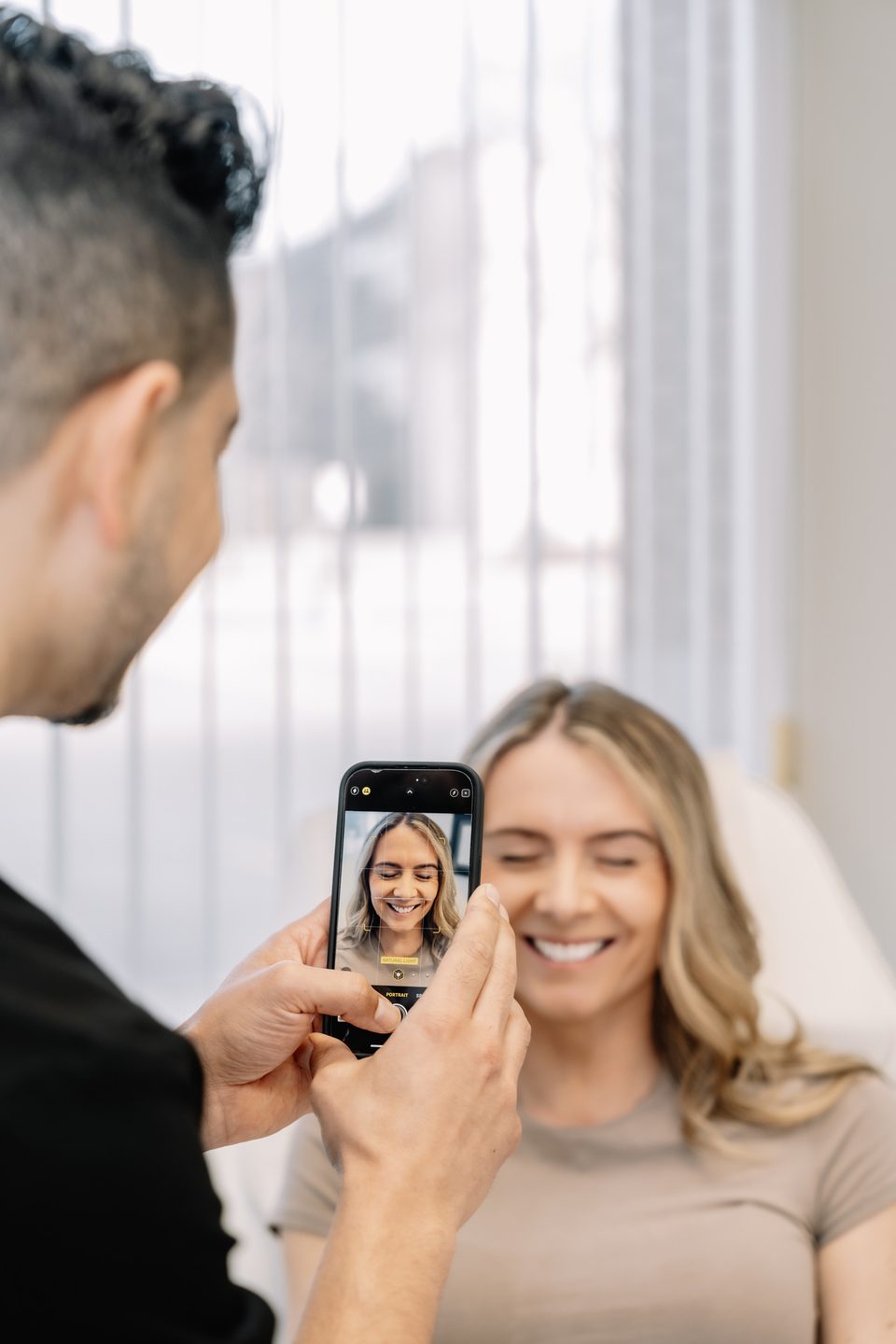
- Photographs
- If your consultation involves surgical planning, particularly for rhinoplasty, clinical photographs may be taken or requested at the visit. They are standardised views used for planning, and they are what allows the office to prepare an accurate written quotation or estimate for any uninsured part of an operation. They are part of your health record, are stored securely, and are never published.
- A questionnaire afterwards
- After your visit, the office may send you a short questionnaire. Its purpose is to refine your concerns and priorities in your own words, once you have had time to think, so that they are captured accurately before any plan is finalised. It is not a commitment to anything.
If you'd like to read independently first
Taking time to decide is normal, and reading beyond any one practice's website is a healthy instinct. These national and provincial resources are non-commercial and clinically credible:
- Canadian Society of Otolaryngology, Head and Neck Surgery: the national specialty society's plain-language information sheets, including nose and sinus conditions.
- Choosing Wisely Canada: clinician-led national guidance on which tests and treatments are genuinely needed, with specific recommendations on sinus disease and imaging.
- Ontario: Your Health: the province's health-services hub, including the free 24/7 Health811 nursing advice line.
03 / 06
Surgery & Recovery
If an operation is the right answer.
Procedure-specific detail lives on each procedure page. These are the parts common to all of them.
Preparing for, or recovering from, an operation? The step-by-step patient guides live in Patient Resources.
Surgery is hospital-based. Elective procedures are generally performed at Joseph Brant Hospital in Burlington; complex endoscopic and skull-base cases are performed at Hamilton General Hospital with the McMaster Skull Base Group. Consultations and follow-up visits take place at the Burlington office.
You'll receive written pre-operative instructions covering fasting, which medications to hold or continue, and arrival time. Blood thinners, anti-inflammatory medications and some supplements may need adjusting beforehand, always in consultation with the prescribing physician. Smoking impairs healing; if you smoke, stopping before surgery genuinely matters.
Arrange for a responsible adult to take you home and stay with you for the first night after a general anesthetic.
Nasal and sinus procedures are usually performed as day surgery under general anesthesia. You go home the same day after a period in recovery. Bring your health card, your medication list, and comfortable clothing that doesn't need to be pulled over your head.
Rest with your head elevated, follow the saline rinse schedule you're given, don't blow your nose until cleared, and avoid strenuous activity and heavy lifting until Dr. Khetani says otherwise. Expect congestion in the early period: it is part of healing, not a sign that surgery failed.
Your written instructions are specific to your operation and take precedence over any general guidance on this website. After endoscopic sinus surgery, the fuller guidance lives on its own page.
Follow-up visits are scheduled as part of the procedure, not as an optional extra, particularly after sinus surgery, where the healing cavities are inspected and gently cleared so they heal open. Keep these appointments even if you feel well.
04 / 06
Information for your specific operation
Everything above applies to nasal and sinus surgery in general. Choose your operation for what is specific to it: how to prepare, what the day looks like, what to expect afterwards, and whether OHIP applies.
What OHIP covers, procedure by procedure
Septoplasty
Insured when medically necessary.Before your operation
- Care begins with a physician referral and a consultation that includes examination and, where indicated, nasal endoscopy.
- You receive written pre-operative instructions: fasting, which medications to hold or continue, and arrival time. Blood thinners, anti-inflammatories and some supplements may need adjusting, always with the prescribing physician.
- If you smoke, stopping before surgery genuinely improves healing.
- Arrange a responsible adult to take you home and stay the first night, and plan several days to a week or so away from desk work.
The day of surgery
- Day surgery under general anesthesia, in hospital, generally Joseph Brant Hospital in Burlington.
- Performed through the nostrils: no external incisions, and no change to the appearance of your nose.
- Soft internal supports are sometimes placed; you are told beforehand if they are planned.
- You go home the same day after a period in recovery. Bring your health card, medication list and clothing that doesn't pull over your head.
Afterwards
- The first days: a congested, stuffy nose and light spotting of blood are expected. Saline rinses, rest with the head elevated, and no nose-blowing are the core of early care.
- Any internal supports are removed at an early follow-up visit.
- Strenuous exercise and heavy lifting generally wait one to two weeks, or until cleared at follow-up.
- Breathing typically improves progressively as swelling settles over the following weeks; the early congestion is not the final result.
Two short videos, Septoplasty: the operation and its risks and After septoplasty: what to expect, are in production and will appear on the septoplasty page.
Endoscopic sinus surgery
Insured when medically necessary.Before your operation
- Surgery is considered only after examination, nasal endoscopy, a sinus CT scan (the map the operation is planned on) and a genuine trial of medical therapy.
- For nasal polyps, biologic medication is weighed alongside surgery; the recommendation is the one that fits your disease.
- Written pre-operative instructions cover fasting and medications, particularly blood thinners and anti-inflammatories.
- Arrange a responsible adult to take you home and stay the first night, and plan roughly one to two weeks away from work depending on your role.
The day of surgery
- General anesthesia, usually as day surgery. Elective cases at Joseph Brant Hospital; complex, revision and skull-base cases at Hamilton General Hospital with the McMaster Skull Base Group.
- Entirely through the nostrils: no external incisions and no facial bruising.
- The natural drainage pathways are opened, polyps and obstructing tissue removed, and the healthy lining preserved.
- You go home the same day in most cases, with your written instructions and a saline rinse schedule.
Afterwards
- Expect congestion and blood-tinged drainage in the first days. Saline rinses matter more than any other single step; do not blow your nose or strain.
- Scheduled follow-up visits are part of the operation: the healing cavities are inspected and gently cleared so they heal open, not scarred. Keep them even if you feel well.
- Chronic sinusitis is a chronic condition. Rinses, sprays and sometimes further medical treatment keep it controlled after surgery, and polyps can recur.
- The complete instructions live on their own page, linked below.
Two short videos, Endoscopic sinus surgery: the operation and its risks and After sinus surgery: what to expect, are in production and will appear on the sinus surgery page.
Rhinoplasty
Cosmetic: not insured · the breathing component may be insured; the rhinoplasty component needs Ministry pre-approvalBefore your operation
- Standardised clinical photographs are taken at the surgical consultation; they are used for planning and to prepare your written quotation for any uninsured part of the operation.
- Where one operation addresses both breathing and appearance, the insured and uninsured parts are identified separately, in writing, before anything is decided.
- Written pre-operative instructions cover fasting and medications. Blood thinners, anti-inflammatories and some supplements may need adjusting with the prescribing physician; if you smoke, stop beforehand.
- Arrange a responsible adult to take you home and stay the first night, and plan one to two weeks away from desk work and social commitments.
The day of surgery
- Day surgery under general anesthesia, in hospital.
- Open or closed approach, chosen for your anatomy and explained beforehand.
- An external splint protects the nose; there may also be soft internal supports.
- You go home the same day. Bring your health card, medication list and clothing that doesn't pull over your head.
Afterwards
- The first week: splint in place, congestion, and bruising or swelling around the eyes that peaks early and then fades. Rest with the head elevated; no nose-blowing.
- Weeks one to two: the splint typically comes off at the first follow-up; visible bruising settles, and many patients return to desk work and social life.
- Weeks two to six: light activity first; strenuous exercise, heavy lifting and contact sports wait until cleared, commonly four to six weeks. Glasses may need to stay off the healing bridge for a period.
- The first year: the last, subtle swelling (especially at the tip) settles gradually; the refined result emerges over months, with changes up to a year or more.
Two short videos, Rhinoplasty: the operation and its risks and After rhinoplasty: what to expect, are in production and will appear on the rhinoplasty page.
General guidance only. Your written instructions are specific to your operation and take precedence over anything on this page.
If something worries you after surgery
Contact the office at (905) 639-2244 during office hours with post-operative questions. For heavy bleeding, difficulty breathing, high fever, severe pain, vision changes or any emergency, do not wait for a call back; go to your nearest emergency department or call 911.
05 / 06
A Note on Photographs
Why there are no before-and-after images here.
Patient images are personal health information. They are shared only with written patient consent and in an appropriate clinical setting, which for this practice means the consultation room, where examples relevant to your anatomy can be discussed properly, rather than a marketing page where the most flattering cases are the ones that get published.
Ontario's rules on physician advertising also restrict how outcomes may be presented publicly. This practice follows both the letter and the intent of those rules.
06 / 06
Common Questions
Practical questions, answered.
Ask your family physician, a walk-in clinic physician, or your nurse practitioner to fax a referral to (905) 639-2253. Include the reason for referral and any relevant imaging or treatment history. The office contacts you directly once the referral is processed.
Wait times vary with clinical urgency; the practice’s current, dated ranges are on the wait times page. The office can give you a realistic expectation for your situation when they contact you, and urgent concerns identified in a referral are triaged accordingly.
Your health card, a current list of your medications and allergies, any prior imaging reports or CDs/discs, and records of previous nasal or sinus surgery if you've had any. If it helps you remember, write your questions down beforehand; most people forget at least one.
Yes. A second set of ears is genuinely useful when surgical options, risks and recovery are being explained. Tell the office when you book so the visit is arranged comfortably.
That's a legitimate outcome of a consultation, and a common one. You'll be given the information you need to make the decision, and where a non-surgical or medical route exists it will be explained. You can also return later if your situation changes.
Calls to (905) 639-2244 are answered promptly at any hour by Phelix, an AI phone assistant built for medical offices. It takes your details and the reason for your call, answers routine questions about referrals, appointments and directions, and creates a task so that anything it cannot settle is picked up by the office team during office hours. You can always ask for a person, post-operative concerns are prioritised, and anything urgent is directed to emergency services. How calls are handled.
Assessment of the nose and sinuses depends on physical examination (and often on endoscopy), so an in-person consultation is expected. Ask the office what is possible for follow-up or preliminary discussion in your particular case.
Still have a question?
The office is the fastest route to a clear answer about referrals, appointments or what to expect.