Surgical Focus
Rhinoplasty, plannedaround the whole nose.
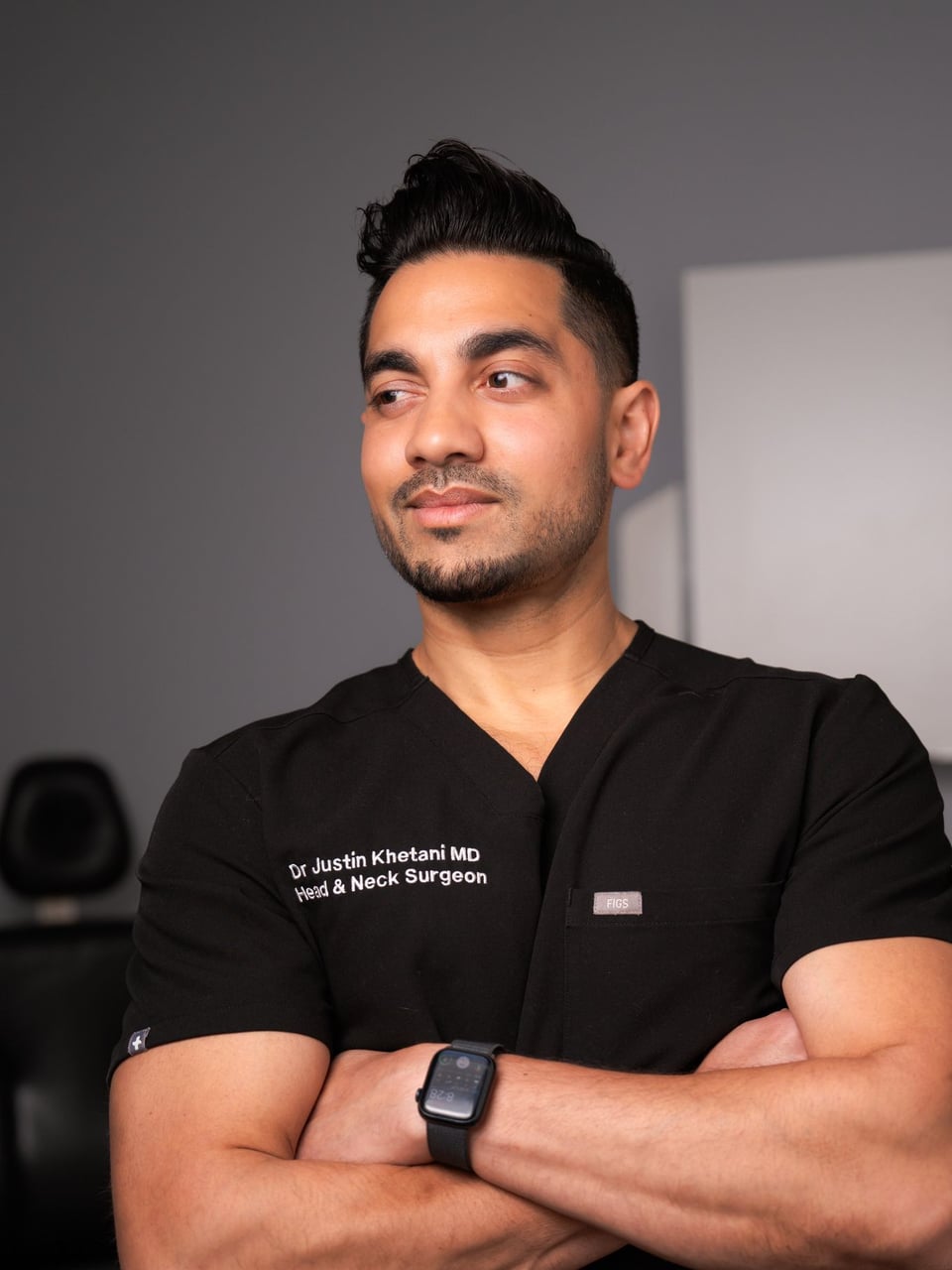
Surgical reshaping of the nose (for appearance, for breathing, or for both) by Dr. Justin Khetani, a Royal College-certified head & neck surgeon whose daily surgical work is the nose and its airway, serving Burlington, Hamilton, Oakville and the surrounding region.
- Setting
- General anesthesia, in hospital
- Pathway
- Cosmetic consultations may be requested directly
Rhinoplasty in Burlington by Dr. Justin Khetani, a Royal College-certified otolaryngologist–head and neck surgeon practising in rhinology: appearance and breathing planned together at one consultation, with honest candidacy first. Surgery to change the appearance of the nose is not insured by OHIP. Fees are quoted in writing after assessment; consultations are requested directly, no referral needed.
Written and reviewed by Dr. Justin Khetani, MD, FRCSC, Otolaryngology–Head and Neck Surgery · Last reviewed
Royal College-certified, Otolaryngology–Head & Neck Surgery, practising in rhinology · Member, Canadian Academy of Facial Plastic & Reconstructive Surgery · Surgery at Joseph Brant Hospital · CPSO register (opens in a new tab)
- Coverage
- Not insured — a written quotation follows your assessment. The breathing component of a combined operation may be insured; the rhinoplasty component needs Ministry pre-approval.
- Referral
- Not required for a cosmetic consultation.
General guidance only. Your candidacy, plan, recovery and costs are individual, and are confirmed at your surgical consultation.
Coverage, Plainly
Two ways rhinoplasty is funded.
Many rhinoplasty patients are hybrid cases: one operation, a breathing component that may be insured and a cosmetic component that is private.
The airflow component · may be insured
Where the operation includes medically necessary airway work, that component is insured under OHIP when medically necessary — OHIP pays the surgeon and the hospital.
The cosmetic component · private
The external, cosmetic component is not insured. Fees are quoted in writing after assessment; because this component is not an insured service, its scheduling is not tied to insured-surgery waitlists.
Where one operation addresses both breathing and appearance, the insured and uninsured parts are identified separately, in writing, before anything is decided. The rhinoplasty part needs written approval from the Ministry of Health; where the Ministry approves it, no additional charge is made for the operation. How pre-approval works, step by step · How OHIP coverage works →
Access · the private stream
- Cosmetic consultation
- Requested directly — no referral needed
- Combined (hybrid) operation
- Scheduling is not tied to insured-surgery waitlists
Figures reviewed: September 2026
Form & Function
Two questions, one operation.
The same cartilage that shapes a profile also holds the airway open, and reshaping one without respecting the other is how noses end up needing revision.
Dr. Khetani approaches rhinoplasty from the inside out. His surgical specialty is the nose and sinuses: septoplasty, nasal valve work and endoscopic sinus surgery are his daily practice, and rhinoplasty is planned with that same structural understanding. Where a deviated septum or another functional problem exists, it can be corrected in the same operation, a septorhinoplasty.
Common reasons patients seek rhinoplasty include a dorsal hump, a drooping or bulbous tip, asymmetry, changes after an old nasal injury, and breathing obstruction that accompanies a structural problem visible from outside.

Candidacy
Right for some noses. Not for all.
Good rhinoplasty candidates are in good general health, have finished nasal growth (generally from the later teens onward, assessed individually) and hold clear, realistic expectations: refinement of your own nose, not a template applied to it.
Some concerns don't need an operation at all. Minor contour irregularities can occasionally be addressed non-surgically, and some noses are better left alone. Because Dr. Khetani offers surgical and non-surgical options, the recommendation you receive reflects your anatomy, not the limits of what the practice can provide. If the honest answer is a smaller plan, or no treatment, that is the answer you'll be given.
Your realistic options, side by side
| Option | What it can address | Trade-offs to weigh |
|---|---|---|
| Surgical rhinoplasty | Structural reshaping of the nose: appearance, breathing, or both in one operation. | Real surgery with real risks and a staged recovery; the refined result emerges over months. |
| Non-surgical contouring | Selected minor contour irregularities, assessed at a medical consultation. | Temporary by design and carries its own risks; it cannot make a nose smaller, correct structure, or improve breathing. |
| No treatment | A legitimate outcome of consultation: some noses are better left alone. | Nothing changes, and sometimes that is the honest recommendation. You can return if your situation changes. |
Set out so you can weigh the options yourself. Which of them genuinely fits your anatomy is established at consultation, and the decision stays yours.
Form follows breathing.
The Operation
Open or closed: chosen for your anatomy.
Rhinoplasty is performed under general anesthesia in hospital, usually as day surgery. Depending on what your nose requires, Dr. Khetani uses either a closed (endonasal) approach or an open approach.
The framework of bone and cartilage is then reshaped conservatively: refining a hump, supporting or refining the tip, straightening what is crooked and, where indicated, correcting the septum and nasal valves in the same operation to protect or improve breathing.
| Approach | Incisions and visibility |
|---|---|
| Closed (endonasal) | All incisions hidden inside the nostrils. |
| Open | Adds a small incision across the columella (the strip of tissue between the nostrils) for full visibility of the nasal framework. |

Surgical planning · Profile analysis
Recovery
What recovery generally looks like.
Every recovery is individual. These are the general patterns most patients can expect, refined for your case at consultation and in your post-operative instructions.
An external splint protects the nose for about the first week, and there may be soft internal supports. Expect congestion, and bruising or swelling around the eyes that peaks early and then fades. Discomfort is usually manageable with the medication plan provided. Rest with your head elevated, and avoid blowing your nose.
The splint typically comes off at the first follow-up visit. Visible bruising generally settles across this period, and many patients feel comfortable returning to desk work and social life within one to two weeks; individual timing varies and is discussed with you beforehand.
Light activity resumes first; strenuous exercise, heavy lifting and contact sports wait until Dr. Khetani clears them, commonly in the four-to-six-week range. Glasses may need to be kept off the healing nasal bridge for a period, with practical workarounds discussed at follow-up.
Most visible swelling resolves in the early weeks, but the last, subtle swelling (especially at the tip) settles gradually. The refined, final result emerges over months, with changes continuing up to a year or more. Follow-up visits track that progress.
The Honest Part
Every operation carries risk. This one is no exception.
Rhinoplasty is real surgery on a structure you see in the mirror every day and breathe through every minute. Its risks include bleeding, infection, the risks of general anesthesia, prolonged swelling, numbness that is usually temporary, asymmetry or contour irregularity, changes in breathing, and dissatisfaction with the result, including the possibility of revision surgery.
Dr. Khetani reviews these candidly at your consultation, in the context of your anatomy and your plan, before you decide anything. A surgeon's training and technique are directed at reducing risk; no surgeon can eliminate it, and you should be wary of anyone who suggests otherwise.
Watch
Rhinoplasty, explained on camera.
Two short videos, in Dr. Khetani's own words: what the operation involves and the risks that come with it, then the honest shape of recovery from the first week to the first year.
Video 1 of 2
The operation and its risks
How appearance and breathing are planned together, open versus closed approaches, what is and is not realistic for a given nose, and the risks reviewed at consultation: bleeding, infection, prolonged swelling, asymmetry, changes in breathing, dissatisfaction and the possibility of revision.
About 5 minutes · captioned · general education, not advice about your case
Video 2 of 2
After rhinoplasty: what to expect
The splint week, bruising and swelling around the eyes, when the splint comes off, returning to work and exercise, glasses, and why the final result takes up to a year to settle.
About 4 minutes · captioned · general education, not advice about your case
The videos are general education, recorded by Dr. Khetani for patients considering or recovering from this operation. They are not advice about your case: risks, recovery and results vary from person to person and are discussed with you individually.
Coverage & Costs
What rhinoplasty costs.
No two rhinoplasties are the same operation, so no two carry the same fee. What you can always expect is a detailed, written quotation before you decide anything.
What determines the fee
- The complexity of the reshaping your nose requires
- Whether cartilage grafting is part of the plan
- Whether an insured functional component is combined
- The operating-room time the plan requires
What the quotation is
A detailed, written quote is provided after your consultation, before you decide. Where one operation addresses both breathing and appearance, the insured and uninsured parts are identified separately, in writing, before anything is decided. There are no surprise figures.
Surgical fees for the cosmetic component of rhinoplasty begin at $8,000. Every quotation is individual, and is provided in writing after assessment.
What OHIP does (and doesn't) cover
Cosmetic rhinoplasty
Surgery to change the appearance of the nose is not insured by OHIP. Fees are quoted in writing after assessment, before you decide. There are no surprise figures.
Functional surgery
Correcting obstructed breathing (septoplasty, valve or turbinate surgery) is insured under OHIP when medically necessary — OHIP pays the surgeon and the hospital. An OHIP-insured assessment begins with a referral from your physician or nurse practitioner.
Combined procedures
Where one operation addresses both breathing and appearance, the insured and uninsured parts are identified separately, in writing, before anything is decided. The rhinoplasty part needs written approval from the Ministry of Health; where the Ministry approves it, no additional charge is made for the operation. How OHIP coverage works →
A practical note: clinical photographs may be taken or requested at your surgical consultation. They support planning and are used to prepare your accurate written quotation.
Common Questions
Rhinoplasty, answered plainly.
In closed (endonasal) rhinoplasty, all incisions are hidden inside the nostrils. In open rhinoplasty, a small additional incision across the columella (the strip of tissue between the nostrils) lets the surgeon lift the skin and see the entire nasal framework directly. Neither is universally better: the choice depends on what your nose needs, and Dr. Khetani explains the reasoning for his recommendation at consultation.
Often, yes. A septorhinoplasty combines cosmetic reshaping with correction of a deviated septum or other internal obstruction, in one anesthetic and one recovery. As a fellowship-trained rhinologist, Dr. Khetani makes this combination central to his practice. The breathing component may be insured; the rhinoplasty component needs Ministry pre-approval. The split is explained in writing beforehand.
Closed rhinoplasty leaves no external incisions. Open rhinoplasty adds a small columellar incision on the underside of the nose, which typically heals to a fine line that most people don't notice. How your skin tends to heal is part of the individual conversation at consultation.
Most patients feel comfortable in public within about one to two weeks, once the splint is off and visible bruising has largely settled. Subtle swelling continues to refine for months. Your own timeline depends on the extent of surgery and how you heal, and Dr. Khetani gives you a realistic expectation for your case before you book anything.
Rhinoplasty is generally considered only once nasal growth is complete, typically from the later teenage years onward, and always assessed individually. Maturity of expectations matters as much as maturity of anatomy, and both are part of the candidacy assessment.
Where one operation addresses both breathing and appearance, the insured and uninsured parts are identified separately, in writing, before anything is decided. The rhinoplasty part needs written approval from the Ministry of Health; where the Ministry approves it, no additional charge is made for the operation. Because the cosmetic portion is not an insured service, its scheduling is not tied to insured-surgery waitlists, and the office can tell you what that means for timing in your case.
Surgical fees for the cosmetic component of rhinoplasty begin at $8,000, and depend on what your operation involves: the complexity of the reshaping, whether grafting is required, whether an insured functional component is combined, and the operating-room time the plan requires. Every quotation is individual and is provided in writing after assessment. Where one operation addresses both breathing and appearance, the insured and uninsured parts are identified separately, in writing, before anything is decided.
Revision rhinoplasty is possible in appropriate cases, but it is more complex than primary surgery and is usually not considered until the nose has fully settled, commonly around a year after the previous operation. Bring any prior operative records you have; candidacy is assessed carefully, case by case.

Start with the assessment, not the operation.
One consultation answers the questions that matter: what's achievable for your nose, what it involves, and whether it's worth doing at all.
If your interest is the appearance of your nose, you can request a consultation directly; no referral is needed. If your concern is breathing or sinus disease, assessment is insured when medically necessary and begins with a referral from your physician.
Patients attend rhinoplasty consultations from across the region: Oakville, Milton, Georgetown, Brampton, Mississauga, Hamilton, Guelph, St. Catharines and the wider Golden Horseshoe are all within about an hour's drive of the Burlington office.